
Southern University of Science and Technology 南方科技大学

Program of Physics for International Students (2019)


I. Introduction
Physics is one of the oldest disciplines of natural science based on experiments, which involves the studies of motions of objects ranging from subatomic to cosmic levels, and the exploring of interactions and transformations of substances. It keeps developing as human explores the Nature. Until the 17th century, the Newtonian mechanics had been established, and the laws of motion of various objects including celestial bodies were well understood. In the late 19th century, physics became a systematic and rigorous discipline that contains mechanics, thermodynamics, electromagnetism, optics, etc., known as classic physics nowadays. The modern physics was developed at the beginning of the 20th century with the establishment of relativity and quantum mechanics. Significant breakthroughs in exploring the fundamental structure of the universe were made that greatly facilitated the development of technology and pushed forward the frontier of human cognition. However, the exploration of nature is far from complete. Many fundamental problems were still not being solved, such as the motion law of celestial objects in cosmic level, a more fundamental structure of elementary particles, and the physics laws of complex and strongly correlated macroscopic materials.
Physics is closely related to many other natural science disciplines. It has been a driving force to various of subjects including mathematics, chemistry, biology, geology, materials science, and information science. In addition, physics also makes great contributions to the revolutions of new technology arising from the theoretical breakthroughs, including nuclear energy, semiconductor, superconductor, laser, aerospace industry, etc. In short, physics plays a very important role in our economy and daily life. Progresses in areas such as fusion energy, novel semiconductor materials, high temperature superconductivity, nanomaterials and quantum information are expected in the foreseeable future, and these progresses will lead to the developments of many other new areas of science and technology.
Physics Department at Southern University of Science and Technology, was established in 2011. It is one of the five earliest departments in SUSTech. At present, its research fields include quantum transport and regulation, surface physics, materials physics, computational physics, condensed matter theory, quantum information and quantum computation, high energy physics and astrophysics (in planning), etc.
II. Objectives and Learning Outcomes
(1) Training objectives
The major provides systematic physics training for students, making them ready for advanced study and frontier research in physics and interdisciplinary disciplines in the future, as well as R&D, production, teaching and management in industrial departments, scientific research institutes and educational departments.
(2) Training requirements
Graduates should meet the requirements of the Ministry of Education on the ideological and political theory and moral education of undergraduates, have certain humanistic literacy and social science knowledge, and meet the following professional training requirements:
1. Solid Mathematical Foundation
2. Systematically and comprehensively grasping the basic theories of Physics
3. Familiar with physics experiment methods and skills
4. Understanding the frontiers and developments of physics or related majors
5. Abundant knowledge of physics and flexible application of physical theory
6. Scientific Spirit, Innovative Awareness and Preliminary Scientific Research Ability
7. Basic knowledge background of related science and Engineering Majors
8. Basic computer programming, application and numerical computing capabilities
9. Ability to consult English documents, write papers and communicate academically
10. Good oral skills and teamwork spirit
III. Study Length and Graduation Requirements
Study length: Four years
Degree conferred: Bachelor of Science degree
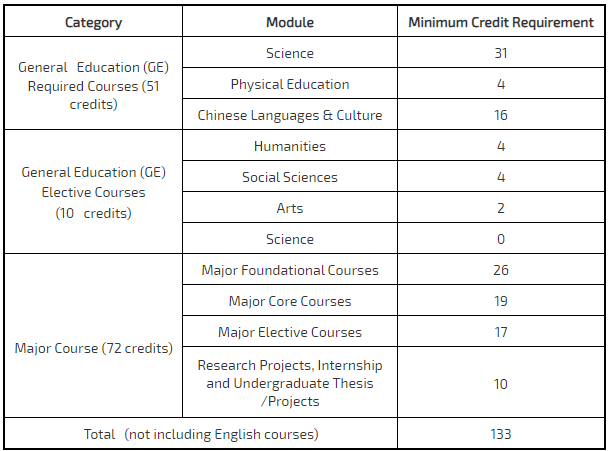
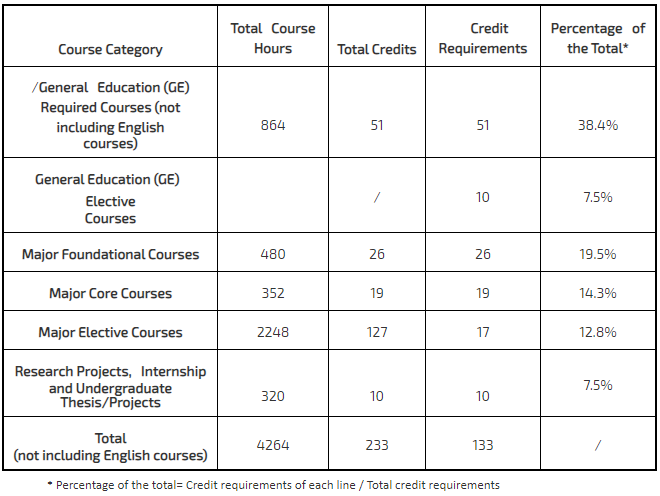
The minimum credit requirement for graduation: 133 credits (not including English courses);
IV. Discipline
Physics
V. Main Courses
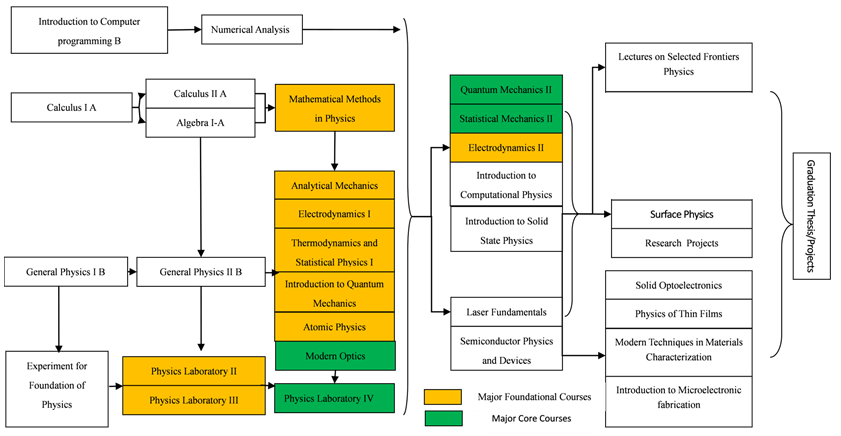
General Physics B (I) and (II), Modern Optics, Atomic Physic, Mathematical Methods in Physics, Analytical Mechanics, Electrodynamics I and II, Thermodynamics and Statistical Physics I, Statistical Mechanics II, Introduction to Quantum Mechanics and Quantum Mechanics II, Introduction to Solid State Physics, Introduction to Computational Physics.
VI. Practice-Based Courses
See Table 3.
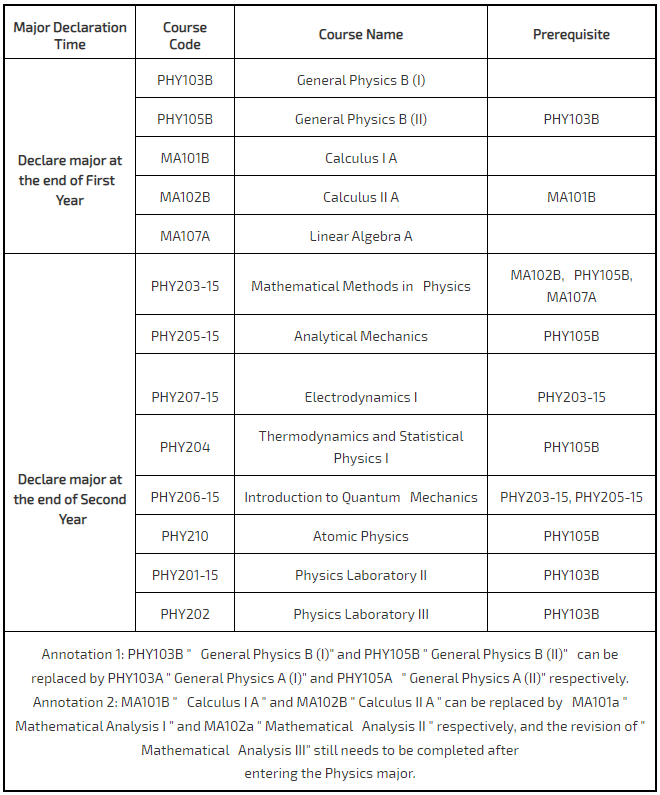
VII. Pre-requisites for Major Declaration
VIII. Requirements for GE Required Courses
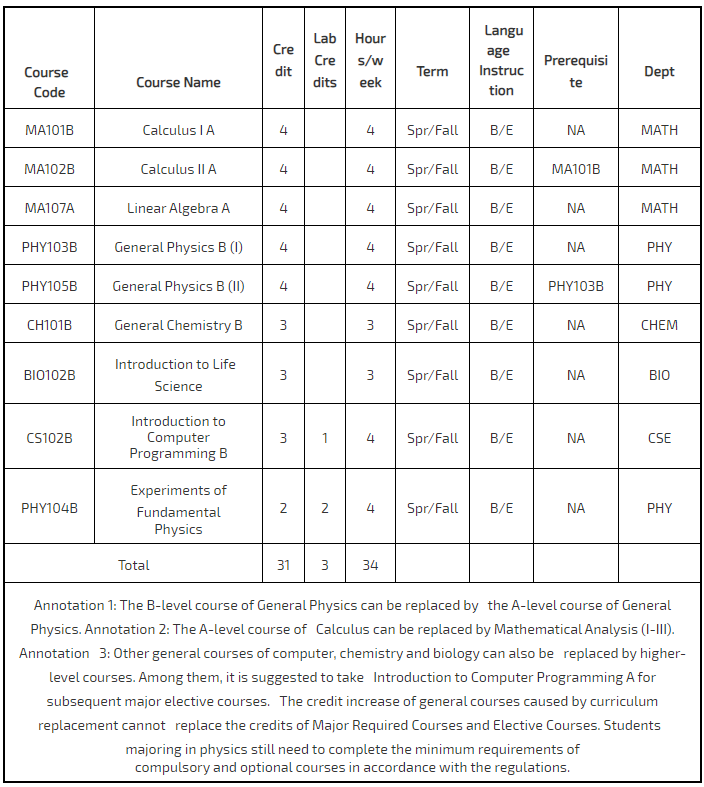
(I) Science Module
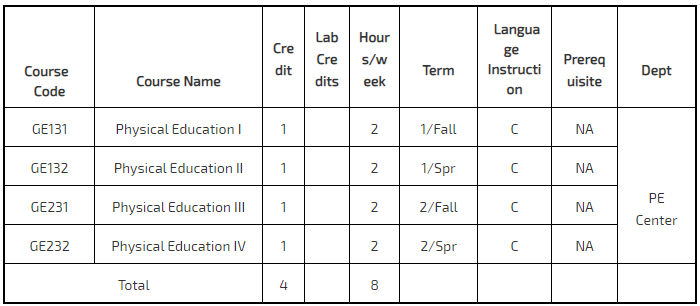
(II) Physical Education
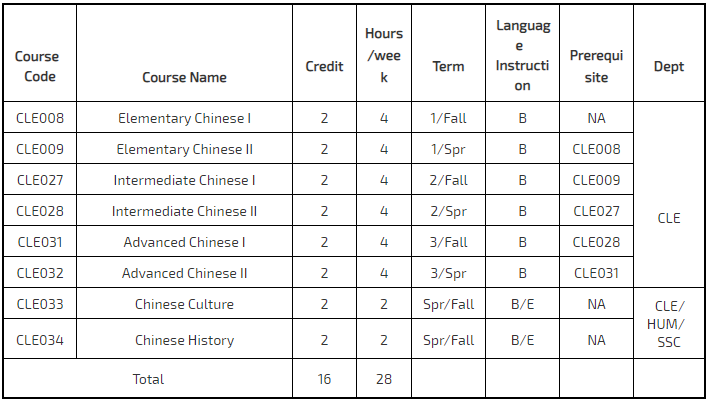
(III) Chinese Languages & Culture
(IV) English Language
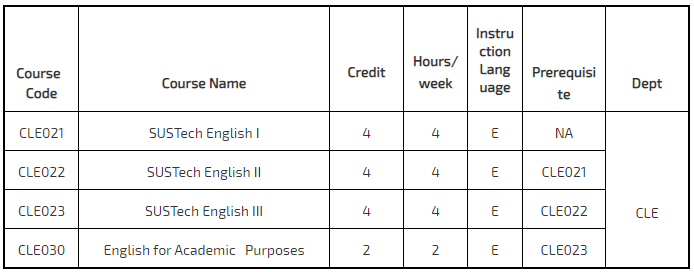
All students are required to undertake the English Placement Test before selecting courses, based on which students will be assigned to 3 levels to be ready for the courses with English as the instruction language.
SUSTech English III, English for Academic Purposes are required for Level A. SUTech English II, SUSTech English III, English for Academic Purposes for Level B.
SUSTech English I, SUSTech English II, SUSTech English III, English for Academic for Level C.
IX. Requirements for GE Elective Courses
(1) Students are required to complete 4 credits for the Humanities Module and Social Sciences Module respectively, and 2 credits for the Music and Art Module. (Information about the available courses and the instruction language will be announced before the course selection session)
X. Major Course Arrangement
Table 1: Major Required Course (Foundational and Core Courses)
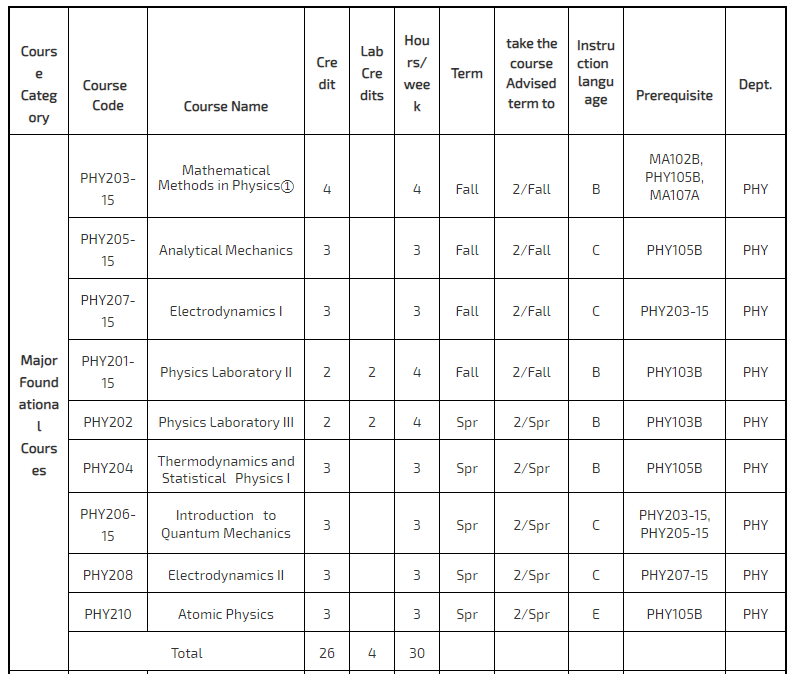
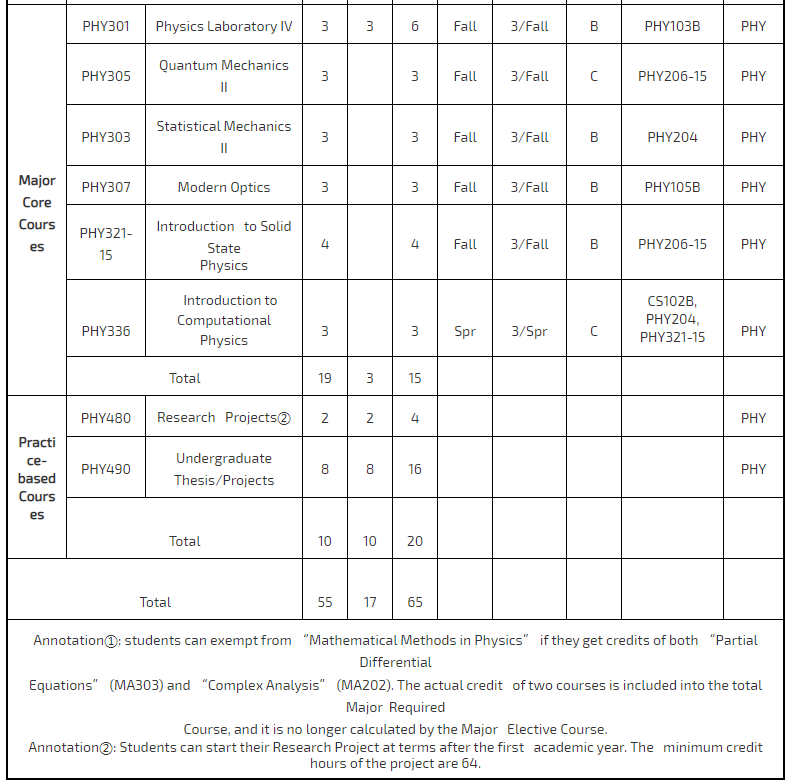
Table 2: Major Elective Courses
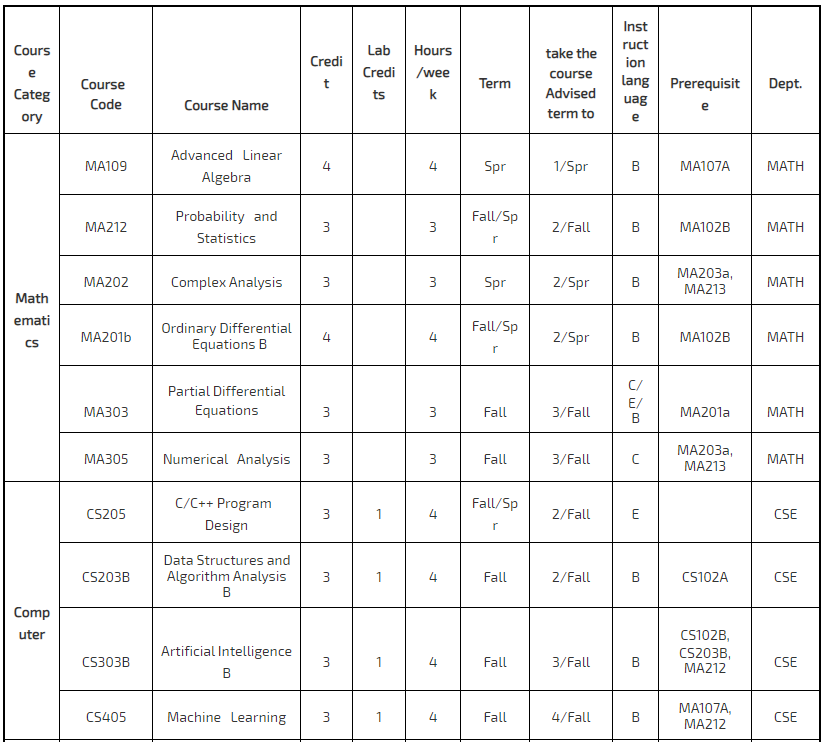
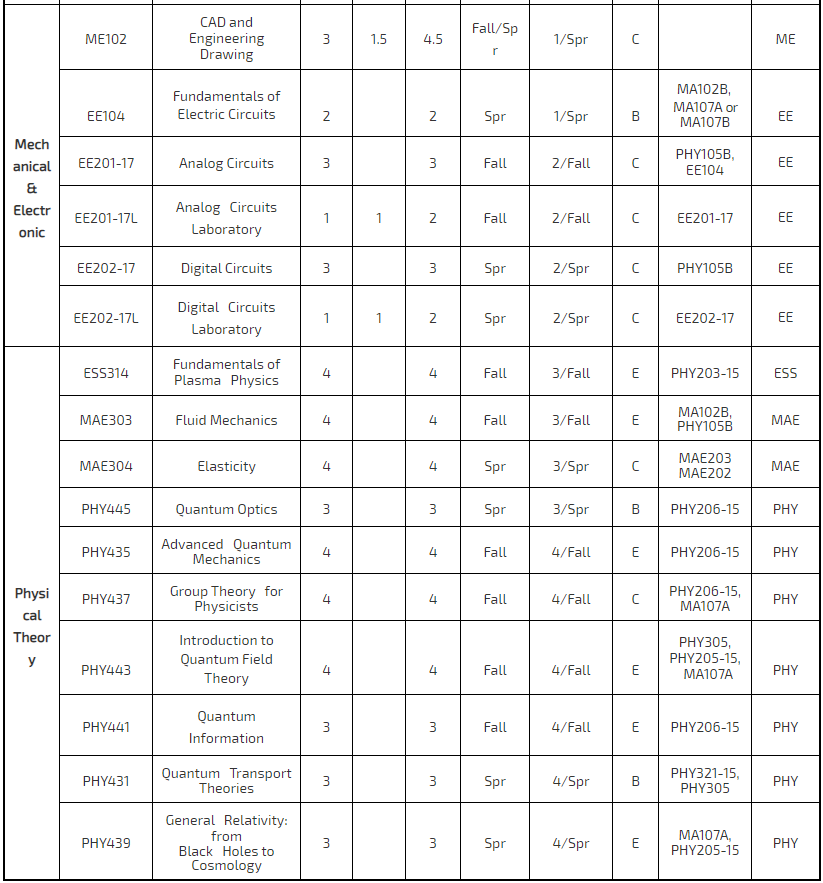
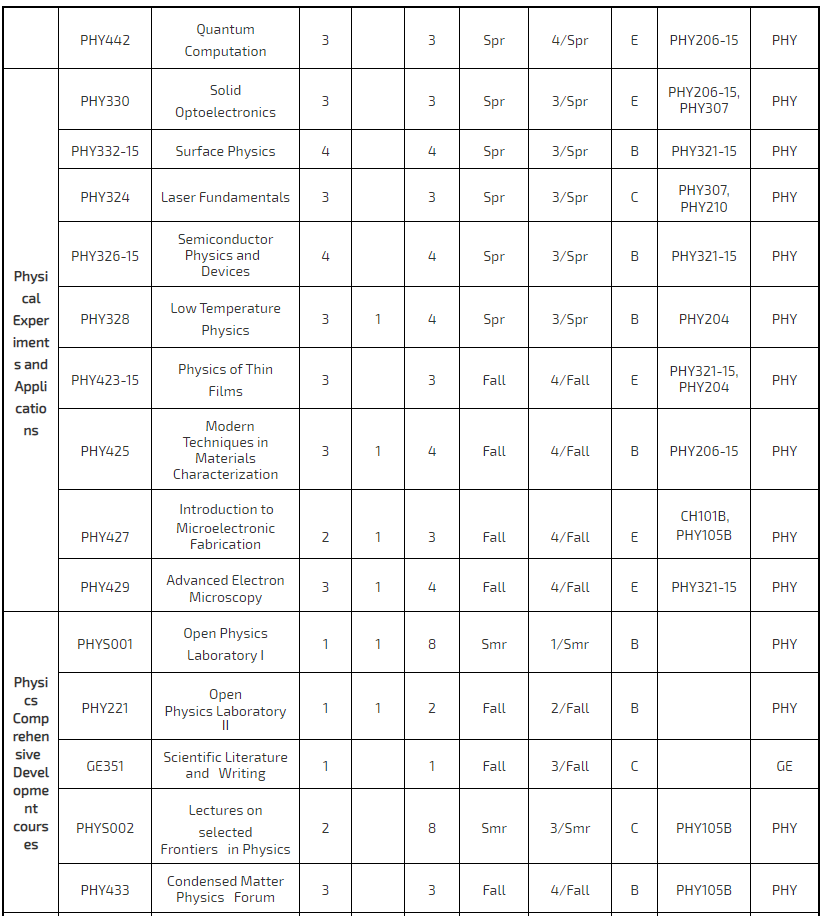
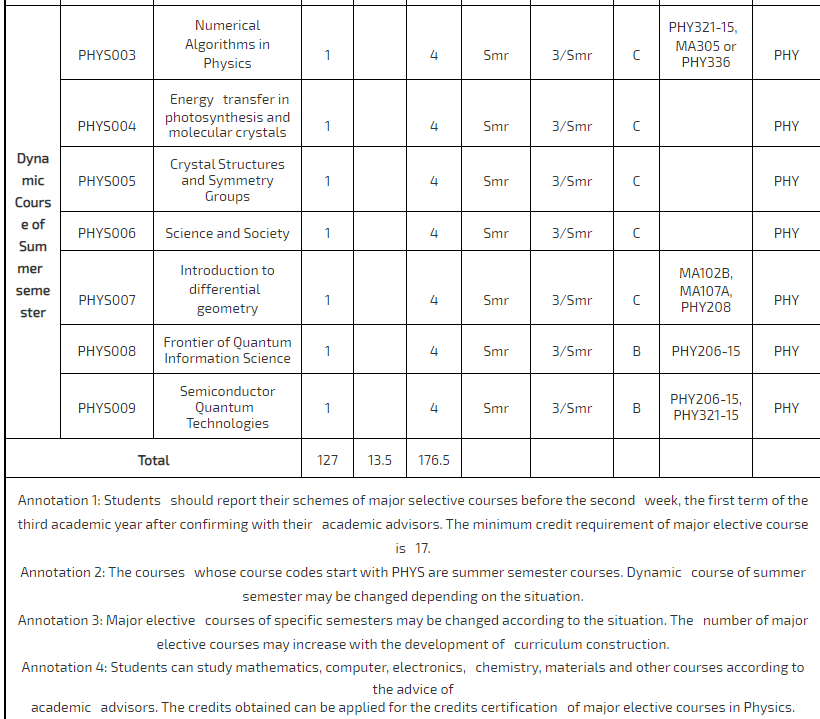
Table 3: Overview of Practice-Based Courses
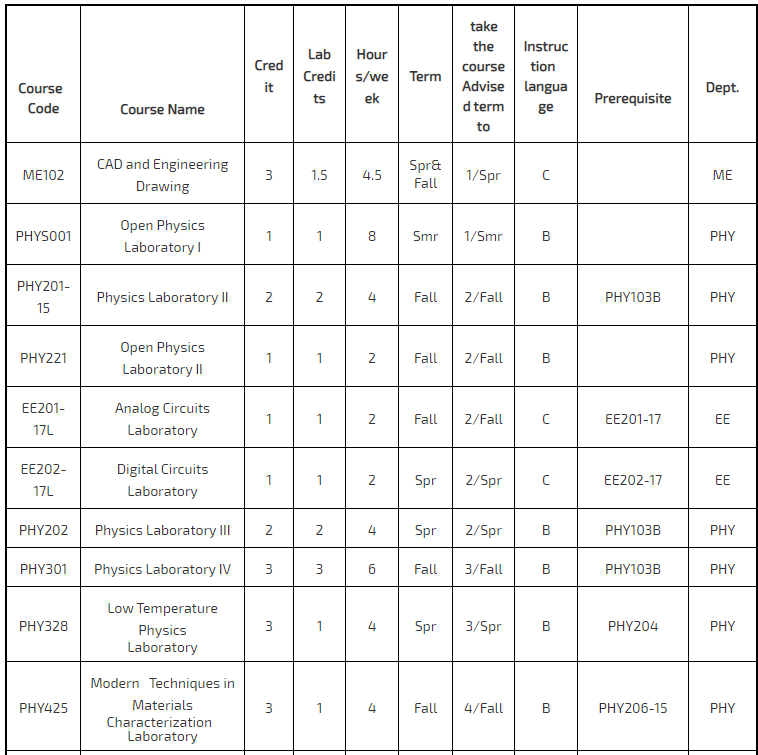
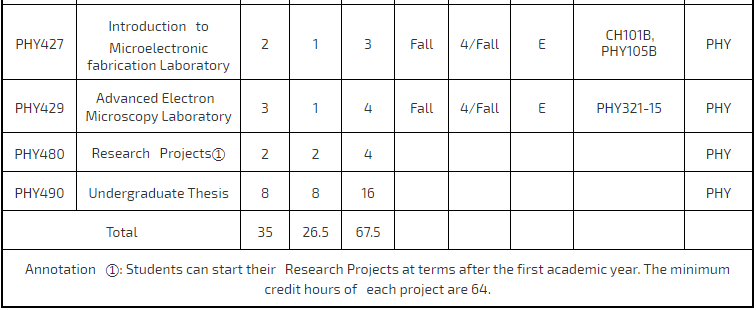
Table 4: Overview of Course Hours and Credits
Curriculum Structure of Physics
京ICP备13028878号-6
