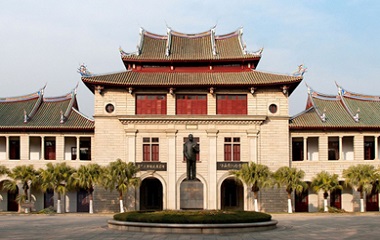




Lim Chia Yan, a Malaysian student at South China University of Technology (SCUT) in Guangzhou, is pursuing a master’s in business administration under the Chinese Government Scholarship, a high-level postgraduate program administered by the China Scholarship Council (CSC). Her academic journey in China began earlier with the Belt and Road Scholarship, which supported her undergraduate studies at Sun Yat-sen University.
According to her, without the CSC scholarship, she might have returned to Malaysia to work after completing her undergraduate degree.
How did she manage to secure scholarships that allowed her to continue her postgraduate studies in China? Lim shares her experience.
Comprehensive understanding of scholarship information is essential
Before applying, Lim was initially confused about the differences between the Type A and Type B Chinese Government Scholarships and the dual application process requiring submissions to both the CSC portal and her chosen university’s website. In her case, she learned that the university application typically precedes the CSC submission, as it often generates a crucial pre-admission notice needed for the scholarship review.
After learning about the CSC-Type A and the CSC-Type B, Lim chose to apply for the latter. This is because the Type A scholarship requires applying through the local Chinese embassy/consulate and obtaining a recommendation, while Type B allows direct application to universities.
Assessing scholarship compatibility
Lim paid close attention to whether a scholarship matched her major and nationality, and also considered how competitive the applicant pool might be.
Given that she is from Malaysia, Lim must choose scholarships that include her country, and she is not eligible for the International Chinese Language Teachers Scholarship.
Lim observed that competition varied significantly by scholarship. A case in point was her unsuccessful bid for a provincial scholarship at Sun Yat-sen University during her undergraduate years. The funding, which provided about 10,000 yuan ($1,380) annually to international undergraduates, proved exceptionally competitive because candidates were evaluated directly against peers from their own major and year—a pool of applicants with highly similar academic records.
Early preparation is crucial for the application process
Lim started preparing her postgraduate application for the CSC scholarship in mid-November, completing the submission in early February the following year. Throughout this process, she found that obtaining a no-criminal-record certificate was one of the most time-consuming steps. Since Lim had studied in China for her undergraduate degree, she chose to apply for the no-criminal-record certificate in China rather than in Malaysia to shorten the processing time. Malaysian high school students, however, must allocate sufficient time for this step.
When applying for postgraduate scholarships, as Lim did, it’s necessary to contact potential supervisors in advance and secure their pre-admission consent before starting the application. Therefore, it is essential to allow enough time for communicating with supervisors.
Study plan and recommendation letters are key
How can I write an outstanding study plan? Lim emphasizes that the content of the study plan must be authentic. She said, “If your academic performance is excellent, highlight your academic experiences. If grades are not your strong suit, focus on extracurricular activities. Everyone has their strengths, so try to describe your advantages as much as possible while cleverly avoiding your weaknesses.”
As for recommendation letters, Lim contacted her professors in advance to confirm their willingness to recommend her. She then drafted the recommendation letters herself and had the professors sign them.
Attention to detail in material submission
Lim’s material submission process went smoothly. She converted all her award certificates, internship verification, and other materials into PDF documents for upload. She said that during the upload process, file naming must comply with the specifications. For example, if the system requires uploading a “passport page”, the file should also be named “passport page.”
She recalled that her application was once returned due to incorrect information filled in on the system. According to her, reviewers usually point out what needs correction, and applicants can revise and resubmit accordingly.
Receiving the scholarship is not the end: Annual reviews require diligence
Whether it is the Belt and Road Scholarship or the Chinese Government Scholarship, once approved, the funding is provided for the entire duration of the study program. The Chinese Government Scholarship offers substantial support, covering tuition fees, medical insurance, and accommodation fees, along with a monthly living allowance of 3,000 yuan. If students choose to live off-campus, they can receive a monthly subsidy of 700 yuan.
Lim´s tuition fee at SCUT is 25,000 yuan per year, and the medical insurance costs 800 yuan per year, all of which was covered by the CSC scholarship.
Although the scholarship is provided for the entire study duration, students must pass annual reviews. To successfully pass these reviews, they must ensure they pass all their course exams.
Lim advises students who plan to apply for scholarships to be patient. The application process requires preparing many materials, and setbacks are common. When encountering problems, stay calm and resolve them step by step. She advises her fellow students to participate in internships and extracurricular activities to enrich their resumes while maintaining good academic performance, increasing their chances of success.